Trade Review Checklist
An options trade review checklist that keeps the decision trail intact.
A useful trade review does not start by judging a win or loss. It starts by preserving the decision context: why the position was opened, what the plan was, what changed, and whether the final action followed the stated process.
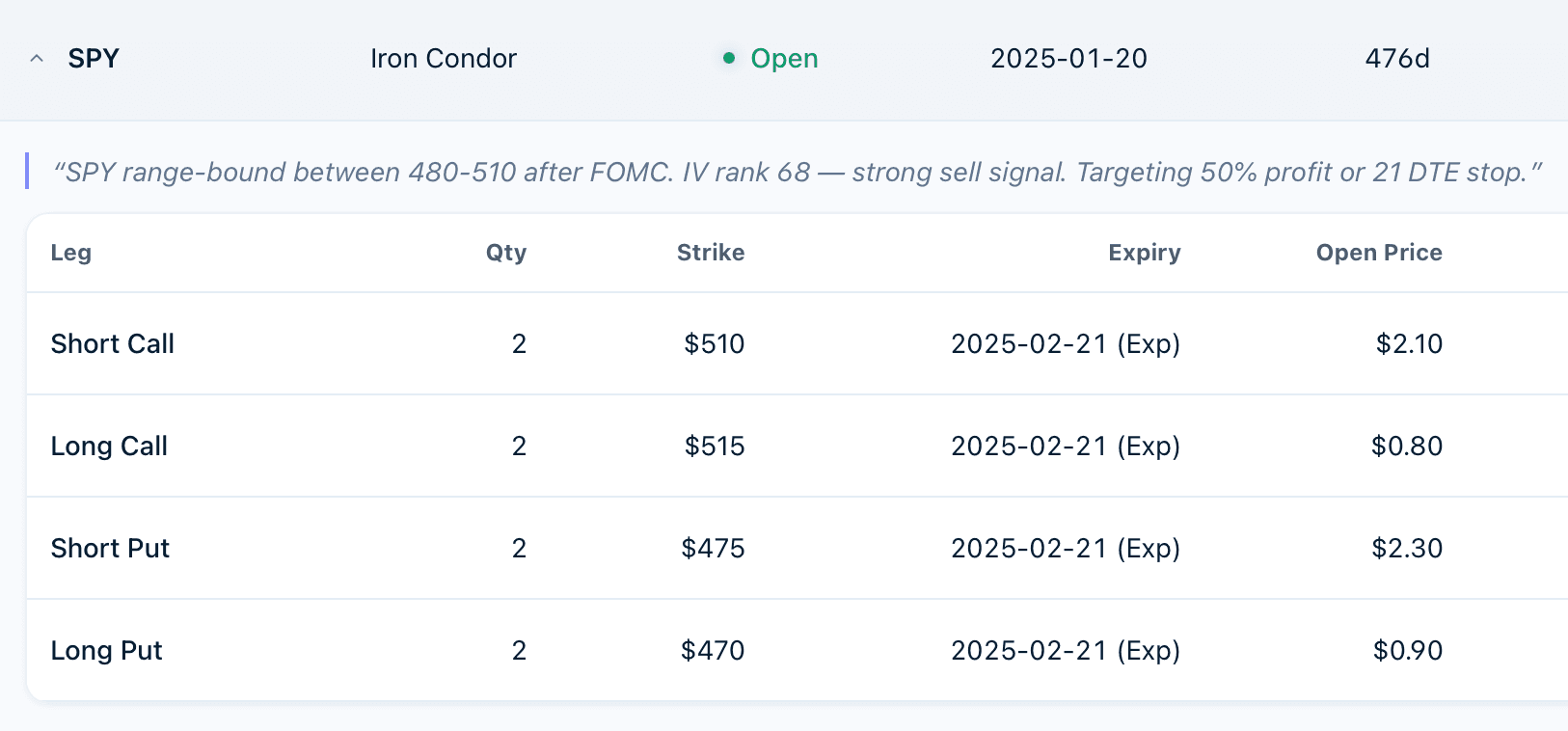
Start the review at entry
Capture the strategy, ticker, legs, expiry, and size, then add the context that cannot be inferred from a fill: the trade thesis, intended hold period, and exit conditions. A short entry note is enough when it states the decision clearly.
The checklist is not a signal generator. It is a way to make your own process visible before hindsight changes how the trade feels.
- What the position is intended to accomplish
- What would invalidate the original plan
- What action would count as a planned exit or adjustment
Record changes while the position is open
When a position is rolled, partially closed, or resized, add the date, action, and reason. That creates a chronological record of management rather than a final result with missing middle steps.
A later review can then distinguish a position that followed its plan from one that changed because of new information, capital constraints, or an unplanned reaction.
Close with a process note, not a verdict
At close, record the realized result, exit reason, and one concise observation about the process. A losing trade can still follow the plan; a profitable trade can still reveal an avoidable risk. Keeping those two ideas separate gives the journal more value than a simple win-rate tally.
Practical checklist
Reusable options trade review checklist
Use these prompts for any strategy, from a single-leg option to a multi-leg spread.
- 1What was the strategy, size, expiry, and opening price?
- 2What was the trade thesis and what would invalidate it?
- 3What was the intended exit, target, or management plan?
- 4Did any roll, partial close, or adjustment occur, and why?
- 5How did the position close, and did the process match the original plan?
Reference material
Sources for options education
These references explain foundational terminology and risks. They are provided for education, not as recommendations.