Iron Condor Journal
An iron condor journal for the full four-leg position.
Iron condor fills can look like four unrelated rows unless the journal treats them as one position. Keep the call spread, put spread, net credit, risk plan, and any adjustment notes together so the final P&L has a clear history.
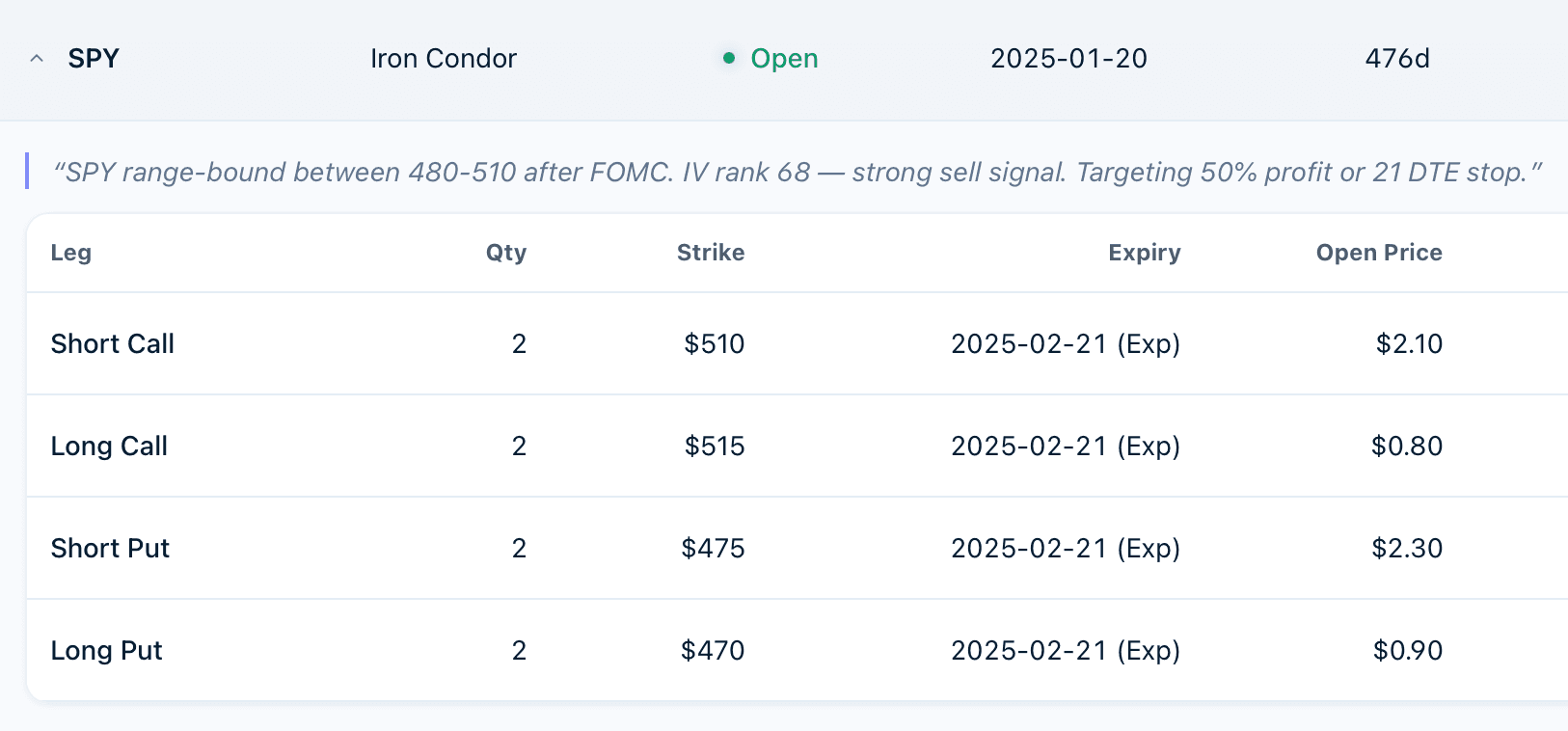
Keep four legs under one trade thesis
An iron condor contains a short and long call plus a short and long put. A row-by-row log may preserve the fills but loses the reason they were opened together. Use one position record with four linked legs and a single trade thesis.
That view makes the opening credit, expiry, wing widths, and intended profit or risk-management point visible without reconstructing the trade from separate transactions.
- All four strikes and their long or short directions
- Expiry, quantity, net opening credit, and wing structure
- Entry conditions, planned management point, and invalidation level
Document adjustments as part of the same position story
A roll, partial close, or added hedge changes the position but should not erase its opening logic. Add the adjustment as a leg or note tied to the original position and state what prompted it.
This makes it possible to review whether adjustment decisions reduced risk, added complexity, or simply delayed a planned exit.
Use expiration and exit notes to improve the next setup
When the position closes, record the reason: target reached, risk threshold reached, expiration, or a manual exit. Pair the final P&L with a short reflection on entry conditions and management. Over time, that information is more useful than a list of credits alone.
Practical checklist
Iron condor journal checklist
The checklist is intentionally position-level, so it still works when the legs were filled separately.
- 1Group all four legs under one position and one opening date.
- 2Record net credit, expiry, and both spread widths.
- 3Write the market condition or thesis behind the range-based trade.
- 4Log each adjustment with its trigger and intended effect.
- 5At close, capture the exit reason and what the review changed for next time.
Reference material
Sources for options education
These references explain foundational terminology and risks. They are provided for education, not as recommendations.